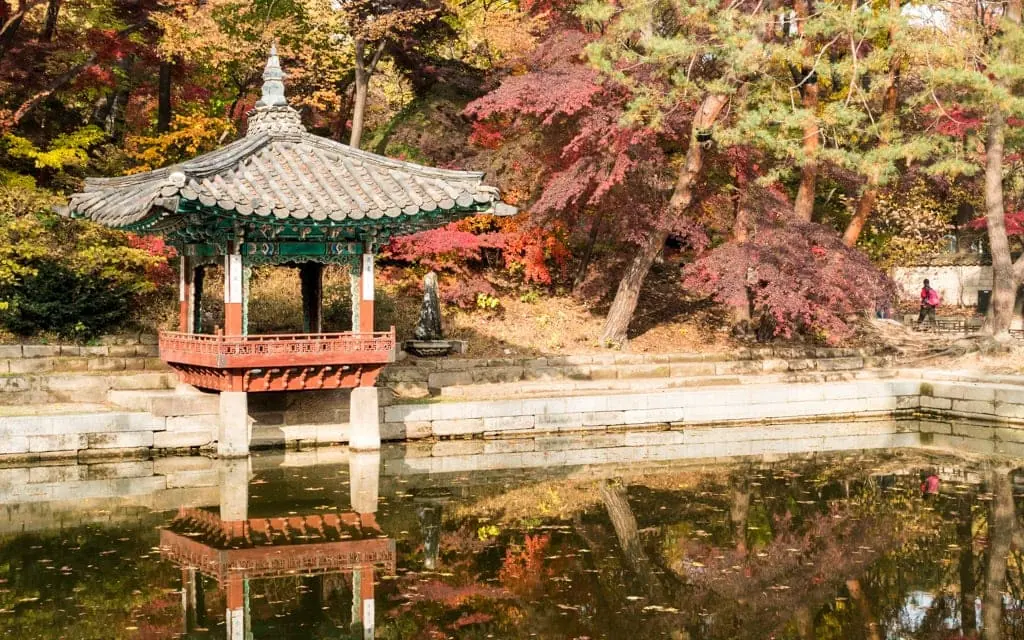
In this guide, I will share with you everything I have learned from my 28 visits to Seoul. This guide is perfect for anyone traveling to Seoul and needing practical, up-to-date information. This includes where you should stay, what to eat, what to see, and how to get around efficiently in 2026.
So why visit Seoul? In just a half-century, Seoul has risen from the ashes of war and transformed itself into a modern-day metropolis. The city is an interesting mix of old and new. You will find 600-year-old palaces in the shadows of brand-new skyscrapers. With an impressive culinary scene, one of the world’s best public transportation systems, and world-class tourist sites, visiting Seoul should be high on every traveler’s list.
Arriving and Departing in Seoul
Seoul has two international airports: Incheon International Airport (ICN) and Gimpo International Airport (GMP). If you are flying into Seoul from another country, odds are you will land at Incheon International Airport, the main gateway to Korea. Those traveling within Korea or from select destinations in Japan and China will often land at Gimpo International Airport.
Visas and K-ETA:
If you are traveling to South Korea, you must check the latest entry requirements. Many visitors, including those from the United States, can enter visa-free for 90 days. However, Korea now utilizes the K-ETA (Korea Electronic Travel Authorization). While some countries are temporarily exempt during specific tourism initiatives, it is important that you check the official K-ETA website before your trip to see if you need to apply at least 72 hours in advance.
Incheon International Airport (ICN)
You will find Incheon International Airport in Incheon, not Seoul. Incheon is located about one hour west of Seoul by train. Not only is Incheon International Airport one of the busiest airports in the world, but it is also consistently ranked as one of the best. Security and customs at Incheon are among the most efficient I have experienced anywhere.
Incheon International Airport is well-connected to destinations in Seoul and beyond.
Options for getting to Seoul from Incheon International Airport
- AREX (Airport Railroad) Express Train: If you need to get to Seoul Station as fast as possible, the AREX Express Train is your best option. This train runs nonstop between Incheon International Airport and Seoul Station in about 43 minutes. I prefer taking the Express Train because it is comfortable, has reserved seating, and offers ample room for luggage. Cost: The standard one-way fare is 13,000 KRW for adults and 9,500 KRW for children. (Note: You can often find discounted tickets online for approximately 11,000 KRW).
- AREX (Airport Railroad) All Stop Train: The All Stop Train is the commuter subway line connecting the airport to Seoul Station. It makes roughly 13 stops, including digital hubs like Hongik University (Hongdae) and Gimpo International Airport. It is cheaper than the Express Line but can be very crowded during rush hour, and there is no dedicated luggage storage. Cost: The fare is distance-based. To Seoul Station, it costs approximately 4,750 KRW from Terminal 1 and 5,350 KRW from Terminal 2.
- Airport Limousine Bus: If you are staying in Gangnam, Myeong-dong, or Jamsil, the Airport Limousine Bus is often the most convenient choice. These deluxe buses drop you directly in front of major hotels, saving you from hauling luggage up and down subway stairs. Cost: Fares range from 17,000 KRW to 18,000 KRW depending on the route.
- Taxi: If you need door-to-door service, a taxi is the most direct option. Cost: A standard taxi to downtown Seoul generally costs between 60,000 KRW and 80,000 KRW depending on traffic. Flat-rate international taxis are also available at the arrivals curb.
Gimpo International Airport (GMP)
Gimpo International Airport, located about 15 kilometers (9 miles) west of downtown Seoul, is much closer to the city center.
Options for getting to Seoul from Gimpo International Airport (GMP)
- AREX All Stop Train: The journey to Seoul Station takes only about 20 minutes. Price: Approx. 1,850 KRW (Base fare + distance charge).
- Seoul Subway Line 5: Connects the airport to downtown Seoul (Jongno 3-ga Station) in about 45 minutes. Price: Approx. 1,750 KRW.
- Seoul Subway Line 9: The “Gold Line” connects the airport to Gangnam (Express Bus Terminal Station). Note that Line 9 has both “Express” and “All Stop” trains. If you are going to Gangnam, the Express train is significantly faster. Price: Approx. 1,750 KRW.
- Taxi: Price: A regular taxi to downtown Seoul will cost approximately 25,000 KRW to 35,000 KRW.
How to get around Seoul
Seoul has one of the best public transportation systems in the world. With hundreds of stations and many subway and bus lines, getting around Seoul is simple and affordable.
Pro Tip for Navigation: Google Maps does not work well for walking directions in South Korea due to local regulations. For accurate navigation, I highly recommend downloading Naver Map or KakaoMap. Both have English language settings and provide real-time transit data.
Payment: T-Money Card vs. Climate Card
1. T-Money Card
This is the standard reloadable transportation card. You can purchase a T-Money card at any convenience store (7-Eleven, CU, GS25) for roughly 3,000 KRW to 4,000 KRW. You then load it with cash at the store or at subway ticket machines. You can use this card to pay for subways, buses, taxis, and even snacks at convenience stores.
2. Climate Card (New for 2024/2025)
If you plan on using public transport heavily, look into the Climate Card. This is an unlimited transit pass that covers most subway lines and buses in Seoul.
- 1-Day Pass: 5,000 KRW
- 2-Day Pass: 8,000 KRW
- 3-Day Pass: 10,000 KRW
- 5-Day Pass: 15,000 KRW
- 7-Day Pass: 20,000 KRW
Note: You must first purchase the physical card for 3,000 KRW (cash only) at a convenience store or subway station service center.
Modes of Transportation
- Seoul Metro: With over 20 lines, the subway is the lifeline of the city. Stations are numbered and color-coded, making navigation easy even if you don’t speak Korean. Cost: The base fare is 1,550 KRW with a T-Money card. Transfers between the subway and bus are free within 30 minutes.
- Buses: Buses are color-coded. Blue buses run on major roads across the city. Green buses connect subway stations to residential areas. Red buses are express commuters to the suburbs. Cost: Base fare for blue/green buses is 1,500 KRW.
- Taxis: Taxis are plentiful and safe. You can hail them on the street (look for a red light in the window, which means empty) or use an app like Uber (often branded as UT) or Kakao T. Cost: The base fare is 4,800 KRW and increases by distance and time. Payment can be made via T-Money, credit card, or cash.
Where to stay in Seoul
Seoul is divided by the Han River. The northern side (Gangbuk) is the historical center, home to palaces and markets. The southern side (Gangnam) is modern, with skyscrapers and high-end shopping.
- Myeong-dong: The tourism hub of Seoul. It is packed with street food, cosmetics shops, and department stores. It is the most convenient place to stay for first-timers, but it can be loud and crowded.
- Insadong: Known for traditional tea houses, art galleries, and antique shops. It is quieter at night than Myeong-dong and feels more culturally immersive.
- Hongdae (Hongik University): The center of youth culture and nightlife. If you want great cafes, busking performances, and clubs that stay open until 6:00 AM, stay here.
- Gangnam: Modern, upscale, and spacious. It is great for luxury shopping and medical tourism, but the tourist sites in the north can be 30–45 minutes away by subway.
Where did I stay?
When I travel to Seoul, I usually base myself near Namdaemun Market and Hoehyeon Station. This area is within walking distance of Seoul Station and Myeong-dong but tends to be slightly quieter and more affordable.
What to eat in Seoul
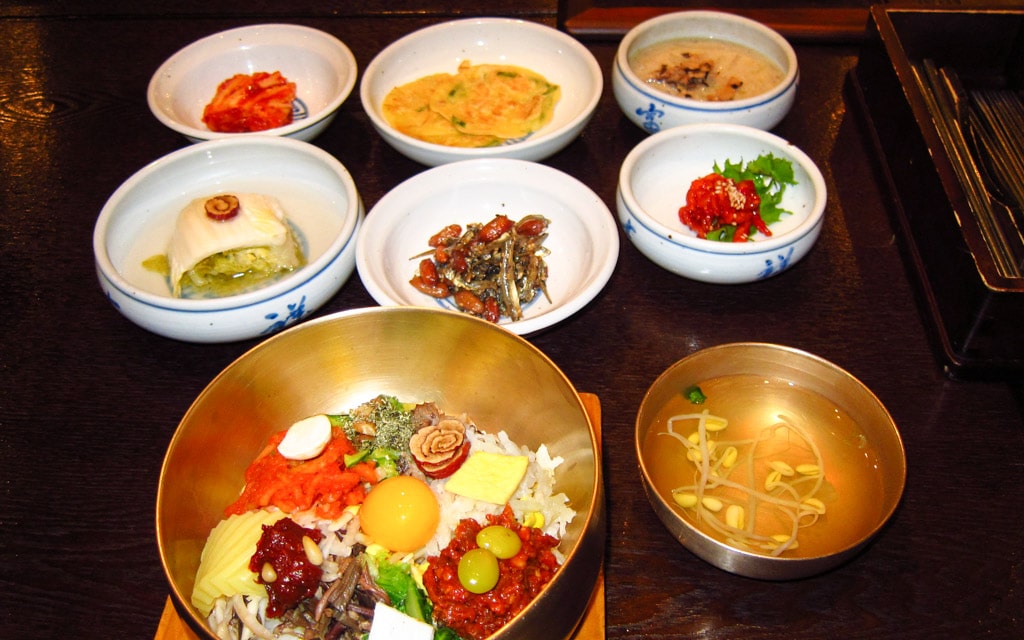
The first time I visited Seoul, I thought I would only be eating Korean BBQ. I was wrong. The culinary scene here is incredibly diverse.
- Banchan (Side Dishes): The unsung heroes of Korean cuisine. These small plates (kimchi, bean sprouts, fish cakes) are provided for free at almost every meal and are refillable.
- Samgyeopsal (Pork Belly): The quintessential Korean BBQ dish. Thick slices of fatty pork belly are grilled at your table and wrapped in lettuce with garlic, spicy paste (ssamjang), and kimchi.
- Dakgalbi (Spicy Stir-fried Chicken): Diced chicken marinated in gochujang and stir-fried with cabbage, sweet potato, and rice cakes. It is spicy, savory, and addictive.
- Samgyetang (Ginseng Chicken Soup): A whole young chicken stuffed with sticky rice, ginseng, and jujube dates, boiled into a rich broth. It is traditionally eaten in the summer to combat the heat, but it is delicious year-round.
Restaurants in Seoul
After 28 trips, these are the restaurants I keep going back to:
- Hadongkwan: Famous for Gomtang, a clear beef bone soup. They have been serving this simple, comforting dish in Myeong-dong for over 70 years. Address: 12, Myeongdong 9-gil, Jung-gu. Price: 15,000 KRW to 18,000 KRW.
- Tosokchon Samgyetang: This is arguably the most famous place in Seoul for Ginseng Chicken Soup. The late President Roh Moo-hyun was a frequent guest. The broth is milky, rich, and nutty. Address: 5, Jahamun-ro 5-gil, Jongno-gu. Price: Approx. 20,000 KRW.
- Yoogane: A reliable chain for Dakgalbi. It is popular with students because it is cheap and filling. Order the “Chicken Galbi Fried Rice” where they fry the rice in the spicy chicken marinade right at your table. Price: Starting around 9,000 KRW per person.
- Ojangdong Heungnamjip: If you want to try authentic cold noodles (Naengmyeon), come here. The noodles are chewy and the sauce is tangy. Address: 114, Mareunnae-ro, Jung-gu. Price: Approx. 15,000 KRW.
- Hanchu: Located in Garosu-gil, this spot is famous for Korean Fried Chicken and deep-fried green peppers stuffed with pork. It is a classic “hof” (beer hall) vibe. Address: 68, Nonhyeon-ro 175-gil, Gangnam-gu. Price: Chicken starts around 21,000 KRW.
Street food in Seoul
- Tteokbokki: Chewy rice cakes in a spicy red pepper sauce.
- Hotteok: A sweet Korean pancake filled with brown sugar, honey, and nuts. It is best eaten hot in the winter.
- Bindaetteok: A crispy, savory pancake made from ground mung beans, often found at Gwangjang Market.
- Gimbap: Rice and vegetables rolled in seaweed. It is the perfect on-the-go snack.
Things to do in Seoul
- Gwangjang Market: This is the premier destination for street food. It was featured on Netflix’s “Street Food” series, and for good reason. Go here for the bindaetteok (mung bean pancake) and kalguksu (knife-cut noodles).
- Noryangjin Fish Market: The market has moved entirely into a modern, clean building next to the old site. You can buy fresh seafood on the ground floor and have it cooked for you in a restaurant on the upper floors.
- Gyeongbokgung Palace: The main royal palace. Try to catch the Changing of the Guard ceremony at 10:00 AM or 2:00 PM. Cost: 3,000 KRW (Free if you wear a Hanbok).
- Cheong Wa Dae (The Blue House): Between 2022 and 2025, the Blue House was open to the public. However, as of late 2025, the presidential office has moved back to the Blue House. As a result, public tours are currently suspended. You can still view the iconic blue-tiled roof from outside the gates or hike the Bugaksan Mountain trails behind it for a view from above.
- Bukchon Hanok Village: A residential neighborhood with hundreds of traditional Korean houses (hanok). Please be respectful of noise levels as people actually live here.
- Cheonggyecheon Stream: An 11km stream that runs through downtown Seoul. It is a beautiful urban renewal project and a great place for an evening walk.
Day trips from Seoul
- Bukhansan National Park: You can reach a national park via the subway. The hike to Baegundae Peak offers incredible views of the city.
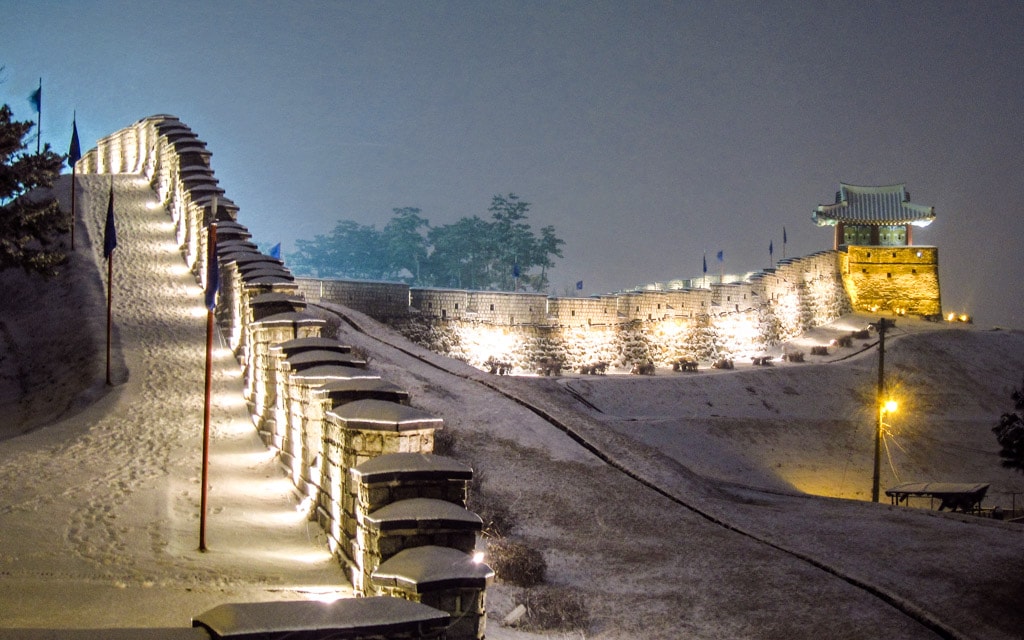
- Suwon Hwaseong Fortress: A UNESCO World Heritage site located about an hour south of Seoul. You can walk along the massive fortress walls that encircle the city center.
- The DMZ: The Demilitarized Zone is the buffer between North and South Korea. Tours to the JSA (Joint Security Area) are subject to military relations and frequent cancellations, but tours to the Dora Observatory and Third Tunnel are generally available.
Last Updated on January 8, 2026